
English
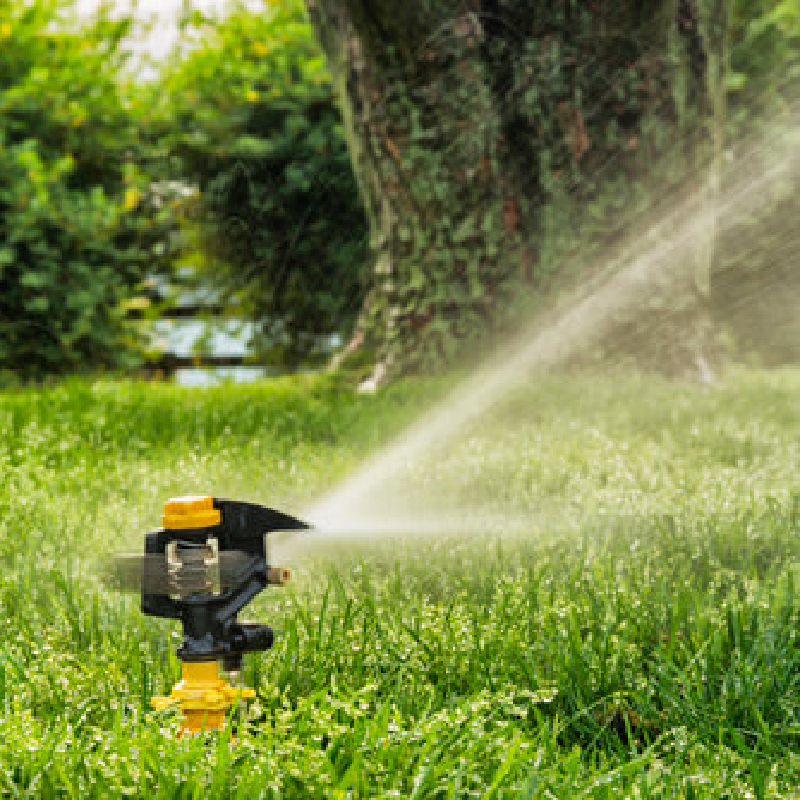
The impact sprinkler, a yard sprinkler created 1932 by a citrus farmer, is the most common piece of irrigation equipment. The first impact sprinklers were mounted atop metal pipes. These raised sprinklers are still used today to water vegetable gardens and landscape beds, as well as for frost prevention for orchards and fruits.
Product Details
PRODUCT DETAILS
Impact sprinklers are typically made of brass or plastic. They are so named because they use the force of the water exiting the nozzle to swing an arm around to make “impact” with the sprinkler frame. This impact causes the sprinkler to rotate slightly. This motion happens repeatedly so that the sprinkler rotates providing coverage of a large area and results in the common “cha-cha-cha” sound as it rotates.
Because of the inconvenience of mowing around the impact sprinklers mounted on pipes, the pop-up impact sprinkler was invented. The same type of sprinkler was enclosed in a cast iron or plastic case 4-6 inches in diameter with a lid on top of the sprinkler head. The enclosed sprinkler case could then be placed in the ground. When water pressure was applied to the sprinkler, it would rise out of the case about 4 inches above the soil surface and spray the surrounding area. When the water was turned off, a spring inside the case would force the sprinkler head and lid back down into the case so it no longer extended above the ground.
These pop-up impact sprinklers had issues as well. A particular brand of high-vacuum mowers would occasionally suck the sprinkler head up out of its casing enough to chop it off. In certain landscapes, sand and dirt would also get into the casing, preventing the sprinkler from retracting leaving it in an extended position. This led to more improvements.
To overcome the problems experienced with pop-up impact sprinklers, manufacturers tried to find a solution that eliminated the need for the large cavity inside the pop-up impact sprinklers. The new design to fix this used an internal drive mechanism.
Rotor and gear driven sprinklers look and work very much the same. While they both have different internal drive mechanisms, they both depend on a flow of water moving past some internal part of the sprinkler. When water pressure is applied, a 1-inch or so diameter shaft extends about 4 inches above the ground. As water flows past the internal drive mechanism, it causes part of the extended shaft to rotate. The shaft is sealed to prevent sand and dirt from entering the sprinkler which helps to eliminate many of the problems with the previous generation of pop-up impact sprinklers. This also made the tops of the sprinklers virtually impossible to see when retracted.
Related Products
In 1985, Datong Locomotive Works realized that electric locomotives were the important development direction of China railway locomotive and rolling stock industry in the future, and put forward the production layout idea of "Nanzhu (Zhuzhou Electric Locomotive Works) and Datong Locomotive Works".
Shaoshan Type 3 electric locomotive is my country’s second generation 6-axle passenger and cargo locomotive. The locomotive adopts bridge-type full-wave rectification and realizes thyristor phase-controlled smooth voltage regulation. The locomotive adopts single-phase AC 25kV 50Hz voltage system and has a maximum operating speed of 100km/h.

The SS3B fixed heavy-duty electric locomotive is a 12-axle freight electric locomotive. It consists of two identical 6-axle locomotives connected by a coupler and a windshield. The two sections are equipped with electrical system high-voltage connectors, control cables, and network shielding. Line and air system control ducts. The entire vehicle can be controlled synchronously from any cab. The locomotive adopts single-phase power frequency system, voltage 25kV, AC-DC transmission, and the maximum operating speed of the locomotive is 100km/h.
Shaoshan 4 improved electric locomotive is an 8-axle freight locomotive. The locomotive consists of two identical four-axle locomotives connected by a coupler and a windshield. The two workshops are equipped with high-voltage connectors for the electrical system, reconnection control cables and air brake system control ducts. The entire vehicle can be synchronously controlled from the driver's cab of any one of the vehicles. The two locomotives can also be separated and used independently as a four-axle locomotive.