
English
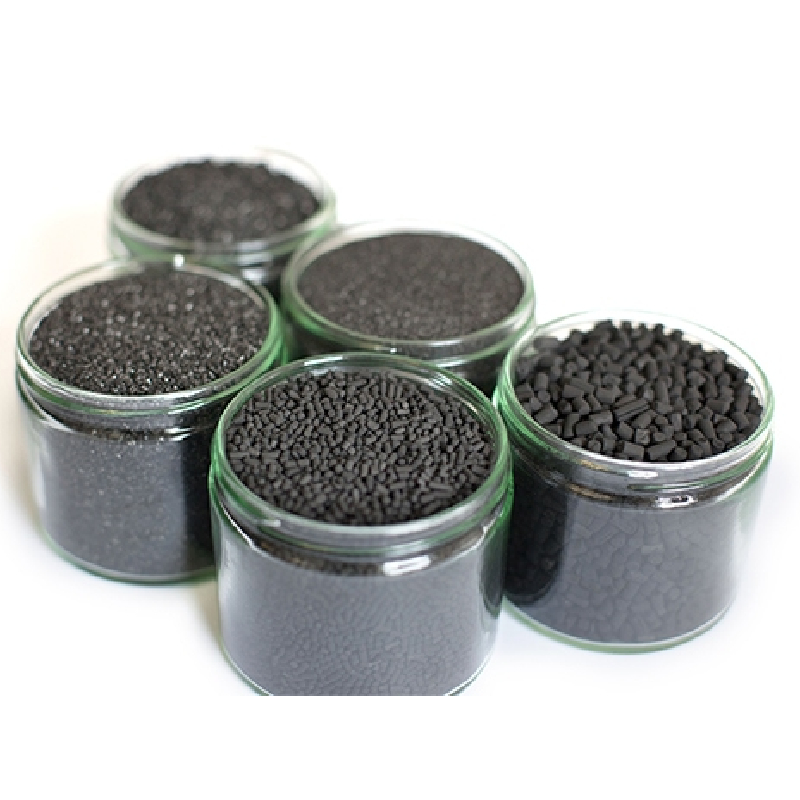
Activated carbon is a porous form of carbon which can be manufactured from a variety of carbonaceous raw materials. The principal commercial products are made from coconut shell, coal, peat or wood. The activation process involves treating the raw material with steam or chemicals, thereby developing a pore structure.
Activated carbon, known as activated charcoal, is characterised by a vast system of pores of molecular size within the carbon particles, resulting in the formation of a material with an extensive internal surface area. Commercially available, activated carbons have surface areas from 400m2/g to more than 2000m2/g.
Product Details
How Does it Work?
The atoms of carbon, comprising the large internal surface area of activated carbon, present attractive forces outward from the surface. These forces, known as Van der Waals forces, attract the molecules of the surrounding gas or liquid.
The combination of these attractive forces and those of molecules in the surrounding medium result in the absorption of molecules at the surface of the activated carbon. Some molecules have structures which make them more easily adsorbed than others and it is due to this that the separation of molecules is achieved.


Activated Carbon Selection
The selection of the most appropriate activated carbon type is based either on known characteristics of the chemicals to be removed in an adsorption process or by a series of controlled laboratory tests.
Powder Activated Carbons
These are mainly used in batch processes and removed by filtration after an appropriate contact time.
● Powdered Carbons
● Pellet Coconut
● Pellet Coal
● Wood Based Carbon
● Activated Carbon Felt
Granular Activated Carbons
Used in fixed or moving bed filters; the smallest particle of activated carbon is normally consistent with the retention in the filter and acceptable flow resistance, since this will provide the best adsorption kinetics.
● Granular Coal
● Granular Coconut
Impregnated Grades
Activated carbon is sometimes chemically impregnated to enhance the performance by chemisorption when the adsorption affinity for particular contaminants is too weak to be effective.
● Silver Impregnated
● Ammonia Removal & Adsorption
● Air Filtration & Odour Removal
● Alkali and/or Ammonia Removal
● Ether Removal
● Formaldehyde Removal
● Gold Recovery & Mercury Adsorption
● h2s, SO2 and Acid Fumes Adsorption
● h2s Removal
● Amine Filtration
● TEDA (Triethylenediamine) Impregnation
Related Products
In 1985, Datong Locomotive Works realized that electric locomotives were the important development direction of China railway locomotive and rolling stock industry in the future, and put forward the production layout idea of "Nanzhu (Zhuzhou Electric Locomotive Works) and Datong Locomotive Works".
Shaoshan Type 3 electric locomotive is my country’s second generation 6-axle passenger and cargo locomotive. The locomotive adopts bridge-type full-wave rectification and realizes thyristor phase-controlled smooth voltage regulation. The locomotive adopts single-phase AC 25kV 50Hz voltage system and has a maximum operating speed of 100km/h.

The SS3B fixed heavy-duty electric locomotive is a 12-axle freight electric locomotive. It consists of two identical 6-axle locomotives connected by a coupler and a windshield. The two sections are equipped with electrical system high-voltage connectors, control cables, and network shielding. Line and air system control ducts. The entire vehicle can be controlled synchronously from any cab. The locomotive adopts single-phase power frequency system, voltage 25kV, AC-DC transmission, and the maximum operating speed of the locomotive is 100km/h.
Shaoshan 4 improved electric locomotive is an 8-axle freight locomotive. The locomotive consists of two identical four-axle locomotives connected by a coupler and a windshield. The two workshops are equipped with high-voltage connectors for the electrical system, reconnection control cables and air brake system control ducts. The entire vehicle can be synchronously controlled from the driver's cab of any one of the vehicles. The two locomotives can also be separated and used independently as a four-axle locomotive.