
English
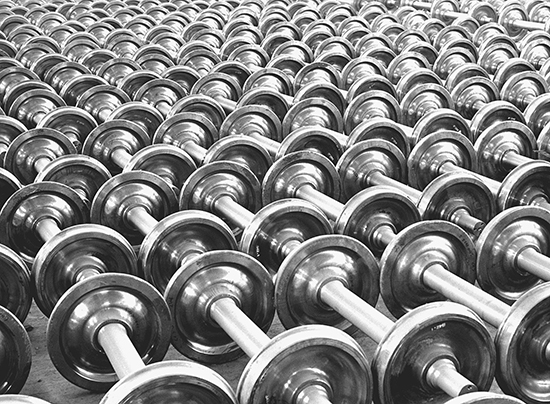
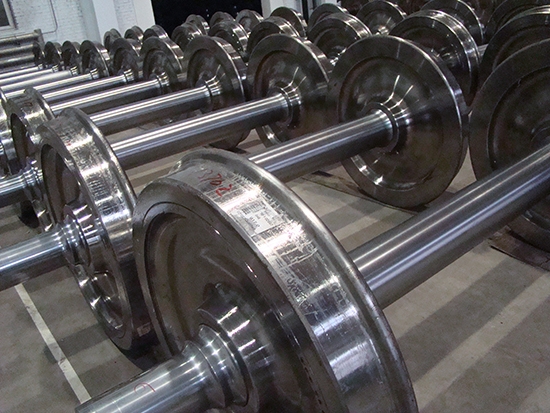
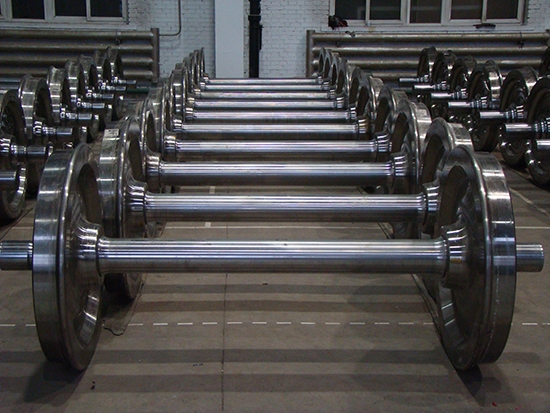
Wheelsets are divided into vehicle wheelsets and locomotive wheelsets. Locomotive wheelsets are divided into steam engine wheelsets, diesel engine wheelsets, electric locomotive wheelsets and moving axle wheelsets of multiple units according to locomotive types.
Product Details
Classification
Wheelsets are divided into vehicle wheelsets and locomotive wheelsets. Locomotive wheelsets are divided into steam engine wheelsets, diesel engine wheelsets, electric locomotive wheelsets and moving axle wheelsets of multiple units according to locomotive types. The moving axle wheelsets of diesel locomotives, electric locomotives and emus are equipped with transmission gears on the axle bodies. Modern high-speed passenger cars and emus adopt disc brakes, and brake discs are installed on the axle bodies or wheels.
The wheelsets of steam locomotives are divided into guide wheelsets, moving wheelsets, driven wheelsets and coal-water wheelsets. The guide wheel pair is located at the front of the locomotive and plays the role of locomotive guidance. The moving wheel pair plays the role of transmitting locomotive power. The driving wheel pair is directly driven by the cylinder piston (piston) through the rocker, and the driving wheel pair is driven by the connecting rod. There are cranks, crank pin holes and balancing blocks in the wheel center of the moving wheel pair, and the cranks of the left and right wheels should have a 90-degree phase difference when assembled. The bearings of the moving wheel and the guide wheel are on the inside of the wheel. The slave wheelset and the coal-water wheelset are similar in shape to the wheelset of passenger and freight vehicles.
Wheelsets can be divided into rolling bearing wheelsets and sliding bearing wheelsets according to the bearing types applicable to axles. The passenger cars of China Railway have all been adopted, and the number of freight cars with rolling bearing wheelsets is increasing day by day.
According to the difference of the maximum allowable axle load (the maximum static pressure exerted by the wheelset on the rail), the wheelset of freight car sliding bearing is divided into four types: B, C, D and E, and the dimensions of the axles and wheels of each type of wheelset are different except the wheel diameter; There are three types of passenger and freight car rolling bearing wheelsets: RC, RD and RE, and there are different journal lengths in the same wheelset due to different models of rolling bearings, so the following numbers are used to distinguish them, such as RC and RD. Axles are forged from medium carbon high quality steel into cylinders with different diameters. According to vehicle types, it can be divided into locomotive axles and passenger and truck axles. According to the bearing type, it can be divided into sliding bearing axle and rolling bearing axle.
Main part
① Wheel seat, where the wheel is pressed, is also the part with the largest diameter on the axle;
(2) journal, the part of the axle that interacts with the bearing;
(3) Axle body, the part between the two wheels. Some axle bodies of passenger and freight cars gradually shrink from the wheel seat to the center, and some axle bodies are cylindrical in length. The transmission gears of diesel locomotives and electric locomotives and the axle-mounted brake discs of locomotive axles with disc brakes are assembled on the axle bodies;
(4) Dust-proof plate seat, the transition between the axle journal and the wheel seat on the axle of passenger and freight cars, on which the dust-proof plate of sliding axle box or the rear baffle of rolling axle box is installed;
⑤ Axle collars, the parts at both ends of passenger and freight car axles that protrude from the axle journals, are used to prevent the sliding bearings from moving excessively on the axle journals, and there are no axle collars on the rolling bearing axles;
⑥ The back shoulder of the journal and the part of the journal near the dustproof plate seat are made into an arc transition to avoid stress concentration caused by sudden change of diameter.
The load on the axle of locomotive and rolling stock is constantly changing, and because the wheelset keeps rotating, alternating stress is generated in the axle. Therefore, the durability limit of axle material must be improved. For this reason, in the manufacturing process, the shaft shaft must be processed by full-length rotary cutting, the journal and wheel seat should be strengthened by rolling, and a load-reducing groove should be set at the wheel seat and the arc transition (rolling bearing) of the journal back shoulder. Strict ultrasonic and electromagnetic flaw detection should be carried out throughout the use period.
Axles are usually solid, but the distribution of axle stress on the cross section is uneven, and the closer to the surface, the greater the stress, while the stress in the center is very small. Therefore, it is possible to use hollow axle instead of solid axle to reduce the harmful influence of unsprung weight on locomotives and lines. Although the hollow axle has been tried for many years in some countries' railways, it is still being studied and improved because of the complicated stress state in use [1].
Wheels
The wheels are pressed on the axle, and the distance between two wheels on the same axle is adapted to the gauge, so that the wheelset can roll on the rail.
The part of the wheel that is in contact with the rail, that is, the outer ring of the wheel, is called the rim on the integral wheel and the tire on the tire wheel. The surface of the rim or tire that contacts the rail is called tread, and the raised part on one side of the tread is called rim. The rim is located on the inner side of the rail, which can prevent the wheelset from derailing and play a guiding role. The part of the wheel that is combined with the axle is called the hub. Hub and rim are connected by spokes. Spokes can be continuous disks, called spokes; It can also be a number of cylinders arranged along the radial direction, called spokes.
According to the structure, wheels can be divided into two categories: tire wheels and integral wheels. The tire wheel is made by installing the tire on the wheel center by hot fitting method and inserting the retaining ring. The retaining ring can prevent the tyre from coming off when the tyre and the wheel center are loose, and play a role of safety stop. Integral wheel is to integrate the tire with the rim on the wheel center. In addition, some countries also adopt wheels with elastic elements between the rim and the web. This kind of wheel is called elastic wheel, which is usually only used on underground railway vehicles.
Force situation
In operation, the contact part of the wheel with the rail bears great pressure and the contact surface produces elastic deformation and great contact stress. In operation, the left and right wheels inevitably roll on the rail with different diameters, resulting in sliding and wheel wear; When braking, the wheel tread is also severely worn by the brake shoes, and high temperature is generated.
All these require that the material of wheel tread must have high strength, hardness, impact toughness and good wear resistance. The hub pressed on the axle mainly bears elastic force, and the spokes or spokes only bear pressure and bending force, which require high toughness.
The tyre and wheel center of the tyre wheel can be made of different materials, so it can better meet the above requirements. The integral wheel is inferior to the tire wheel in tread wear resistance, but it is lighter in weight and less expensive. More importantly, the tire will not relax and crack. China Railway still uses tire wheels on locomotives, and all passenger and cargo vehicles have used integral steel wheels.
Wheel diameter
The nominal value of the wheel diameter is the diameter of the rolling circle (the circle formed by the intersection of the plane parallel to the inner side of the wheel and the tread of the wheel). The wheel diameters of freight cars, passenger cars, internal combustion engines and electric locomotives used in China Railway are 840mm, 915mm, 1050mm and 1250mm respectively. The diameter of various wheels of steam locomotive varies with the model, and the diameter of moving wheels is usually between 1370 and 2000 mm.
Tread shape
The contour line formed by the wheel rim and tread on the radial section of the wheel. The choice of the wheel rim and tread shape not only affects the wear and service life of the wheel, but also directly affects the curve passing performance and running quality of the locomotive and vehicle. The rim enables the wheels to pass through curves and turnouts reliably without derailing. The tread is conical, with a taper of 1:10 near the rolling circle.
When passing through a curve, the outer wheel rolls on the outer rail with a larger diameter close to the rim, and the inner wheel rolls on the inner rail with a smaller diameter, so that on the one hand, the wheelset plays a guiding role with the change of the line direction, and at the same time, the difference in rolling distance between the inner wheel and the outer wheel can compensate for the influence of the difference in the length of the inner rail and the outer rail.
When running in a straight line, if the wheelset deviates from its center position on the line, the difference between the rolling radii of the two wheels will make the wheelset move in the direction of restoring its center position. The taper of the outer side of the wheel is 1:5, which can increase the difference between the rolling radii of the two wheels of the wheelset and make it easy to pass through the small radius curve. However, the conical tread is also the root of the snake-like motion of locomotives and vehicles and affects the running quality. Reducing the taper of tread is helpful to restrain the hunting motion, but the wheel rim wear is obviously aggravated, and the wheel cycle and wheel service life are greatly shortened.
This method is only used on some high-speed passenger trains. On the other hand, the tread profile of wheel rim wears faster at the initial stage of operation, and then tends to be stable and the wear slows down. After rotary repair, the shape can not be maintained for a long time, and the metal cutting amount is very large. Therefore, the railways in some countries have adopted a kind of wheel tread profile which is close to the relatively stable state of wear, and it is also called wear tread. Adopting this shape can not only reduce the wheel wear and prolong the rotary repair cycle, but also reduce the contact stress because of improving the wheel-rail contact state.
Related Products
In 1985, Datong Locomotive Works realized that electric locomotives were the important development direction of China railway locomotive and rolling stock industry in the future, and put forward the production layout idea of "Nanzhu (Zhuzhou Electric Locomotive Works) and Datong Locomotive Works".
Shaoshan Type 3 electric locomotive is my country’s second generation 6-axle passenger and cargo locomotive. The locomotive adopts bridge-type full-wave rectification and realizes thyristor phase-controlled smooth voltage regulation. The locomotive adopts single-phase AC 25kV 50Hz voltage system and has a maximum operating speed of 100km/h.

The SS3B fixed heavy-duty electric locomotive is a 12-axle freight electric locomotive. It consists of two identical 6-axle locomotives connected by a coupler and a windshield. The two sections are equipped with electrical system high-voltage connectors, control cables, and network shielding. Line and air system control ducts. The entire vehicle can be controlled synchronously from any cab. The locomotive adopts single-phase power frequency system, voltage 25kV, AC-DC transmission, and the maximum operating speed of the locomotive is 100km/h.

Shaoshan 4 improved electric locomotive is an 8-axle freight locomotive. The locomotive consists of two identical four-axle locomotives connected by a coupler and a windshield. The two workshops are equipped with high-voltage connectors for the electrical system, reconnection control cables and air brake system control ducts. The entire vehicle can be synchronously controlled from the driver's cab of any one of the vehicles. The two locomotives can also be separated and used independently as a four-axle locomotive.