
English
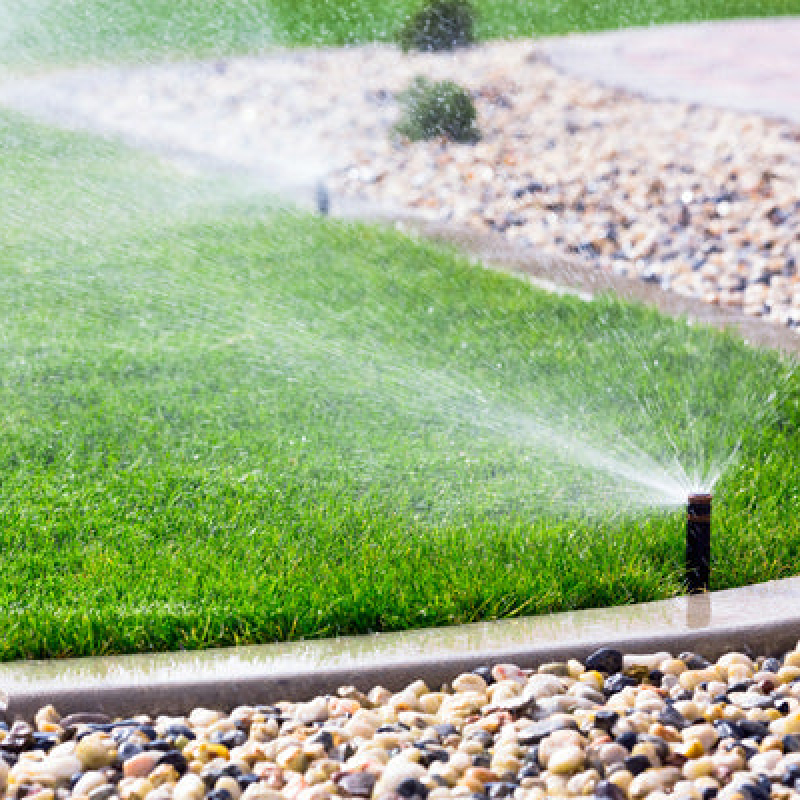
Spray heads get their name because they spray water over an area rather than emitting a stream of water. The type of nozzle used on the spray head determines its pattern of irrigation. When purchasing spray heads, you can choose from heads with a variety of patterns such as full circle, half circle, third circle, quarter circle, and more. You can also buy adjustable arc nozzles. You can even choose rectangular pattern nozzles. Different size nozzles yield different size diameters of throw such as 16, 20, 24, or 30 feet. You can also buy nozzles with different pop-up heights from 2 inches to 12 inches. These heads are usually used in landscape beds or areas too small for sprinklers and stream rotors.
Product Details
PRODUCT DETAILS
Drip irrigation is different from irrigation using sprinklers and spray heads. The latter apply water over an entire coverage area, while drip irrigation applies water only to the root zone area. Drip irrigation allows you to apply water to plants without applying it to surrounding areas which may not require water. It also allows you to irrigate any time of day since the foliage of the plant never gets wet virtually eliminating the chance for disease. Because water is applied directly to the ground, such systems are very efficient.
Drip emitters allow you to regulate the amount of water that is “emitted” from an irrigation line. They are designed such that they emit water at a relatively steady flow rate regardless of pressure.
If a pipe has holes drilled in at some regular interval such as every foot, then when water is supplied to one end of the pipe, the water emitted through the hole closest to the water source will emit some amount of water. Each subsequent hole in the pipe would emit slightly less water as the pressure will be less the farther you get from the water source. If, however, you placed emitters at each hole along the pipe, all the drip emitters would emit roughly the same amount of water.
Drip emitters come in different shapes, sizes, and colors. Some of the common flow rates are 0.5 gallons (or two liters) per hour, 1 gallon (or 4 liters) per hour, and 2 gallons (or 8 liters) per hour. Emitters with all three flow rates can be placed on the same section of drip tubing, and each will emit the amount of water corresponding to their flow rate. How the emitter flow rates are labeled depends on whether they are sold in the US (gallons) or overseas (liters). Some emitters have multiple outlet emitters to which you can attach 5 or 6 pieces of ¼ inch spaghetti tubing to provide water to several plants or pots.
Related Products
In 1985, Datong Locomotive Works realized that electric locomotives were the important development direction of China railway locomotive and rolling stock industry in the future, and put forward the production layout idea of "Nanzhu (Zhuzhou Electric Locomotive Works) and Datong Locomotive Works".
Shaoshan Type 3 electric locomotive is my country’s second generation 6-axle passenger and cargo locomotive. The locomotive adopts bridge-type full-wave rectification and realizes thyristor phase-controlled smooth voltage regulation. The locomotive adopts single-phase AC 25kV 50Hz voltage system and has a maximum operating speed of 100km/h.

The SS3B fixed heavy-duty electric locomotive is a 12-axle freight electric locomotive. It consists of two identical 6-axle locomotives connected by a coupler and a windshield. The two sections are equipped with electrical system high-voltage connectors, control cables, and network shielding. Line and air system control ducts. The entire vehicle can be controlled synchronously from any cab. The locomotive adopts single-phase power frequency system, voltage 25kV, AC-DC transmission, and the maximum operating speed of the locomotive is 100km/h.
Shaoshan 4 improved electric locomotive is an 8-axle freight locomotive. The locomotive consists of two identical four-axle locomotives connected by a coupler and a windshield. The two workshops are equipped with high-voltage connectors for the electrical system, reconnection control cables and air brake system control ducts. The entire vehicle can be synchronously controlled from the driver's cab of any one of the vehicles. The two locomotives can also be separated and used independently as a four-axle locomotive.