
English
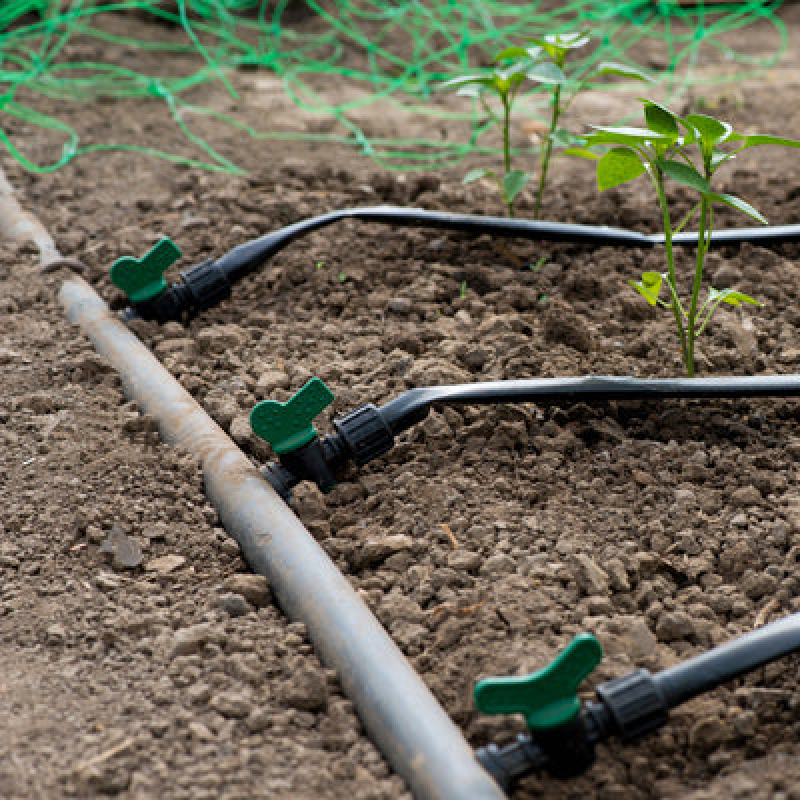
Drip tubing can range in diameter from ¼ inch up to 1.5 inches or more in a variety of styles and is always black. It can be purchased in 100-, 500-, or 1000-foot rolls. Common drip tubing diameters include 3/8-inch (10 mm or “380” size), 1/2-inch (13 mm or “500” size), 5/8-inch (16 mm outside or “600” size), and 5/8-inch (16 mm inside or “630” size). The 5/8-inch tubing (sizes “600” and “630”) are most popular. Because it is made to be resistant to sunlight, drip tubing can last 30+ years in the sun.
Product Details
PRODUCT DETAILS
There are all types of fittings that can be attached to the drip tubing, but the size of the fitting must match that of the tubing. There are “T”s, elbows, and adaptors to connect to male or female garden hose threads to name a few. The open end of the tubing should be plugged with a figure 8 clamp.
Driplines in 1000+ foot rolls that are made of “600” size drip tubing with emitters pre-installed every 12, 18, or 24 inches can be purchased. The emitters are evenly spaced, so they are a great option if you plan to irrigate a bed with a 2x2 grid of emitters or in an orchard or area with evenly spaced plants. However, if the plants to be watered by the drip tubing and emitters are not evenly spaced, then you are better off purchasing drip tubing and emitters so that you can better space the emitters to match your planting pattern.
Microsprinklers and microsprayers are miniature plastic sprinklers and sprayers that are usually mounted atop some type of plastic stake. They are connected to one end of a length of spaghetti tubing which is connected to drip tubing on the other end. These are hybrids of drip irrigation and sprinkler irrigation technology, making them more efficient than sprinklers but still less efficient than drip emitters.
Microsprinklers can have flow rates of 5-60 gallons per hour, sometimes more. They are used a lot in greenhouses and orchards. They are also useful in landscapes with coarse, sandy soils. Drip emitters are not good in such environments because the soil drains so well that the water from the emitter drains vertically and there is very little lateral movement of the water away from the emitter. This limits coverage in the root zone. Because microsprinklers spray water over a much larger area, they are more effective irrigating a much larger root area. Microsprinklers are used extensively in citrus groves, where the soil is sandy.
In areas where the soil is predominantly loamy or clay, the vertical drainage is much slower and lateral water movement from the drip emitter are often 2 or more feet (as opposed to 4-6 inches in sandy soil). In landscapes with loam or clay soils, a drip emitter is quite effective and microsprinklers are not typically used.
Related Products
In 1985, Datong Locomotive Works realized that electric locomotives were the important development direction of China railway locomotive and rolling stock industry in the future, and put forward the production layout idea of "Nanzhu (Zhuzhou Electric Locomotive Works) and Datong Locomotive Works".
Shaoshan Type 3 electric locomotive is my country’s second generation 6-axle passenger and cargo locomotive. The locomotive adopts bridge-type full-wave rectification and realizes thyristor phase-controlled smooth voltage regulation. The locomotive adopts single-phase AC 25kV 50Hz voltage system and has a maximum operating speed of 100km/h.

The SS3B fixed heavy-duty electric locomotive is a 12-axle freight electric locomotive. It consists of two identical 6-axle locomotives connected by a coupler and a windshield. The two sections are equipped with electrical system high-voltage connectors, control cables, and network shielding. Line and air system control ducts. The entire vehicle can be controlled synchronously from any cab. The locomotive adopts single-phase power frequency system, voltage 25kV, AC-DC transmission, and the maximum operating speed of the locomotive is 100km/h.
Shaoshan 4 improved electric locomotive is an 8-axle freight locomotive. The locomotive consists of two identical four-axle locomotives connected by a coupler and a windshield. The two workshops are equipped with high-voltage connectors for the electrical system, reconnection control cables and air brake system control ducts. The entire vehicle can be synchronously controlled from the driver's cab of any one of the vehicles. The two locomotives can also be separated and used independently as a four-axle locomotive.